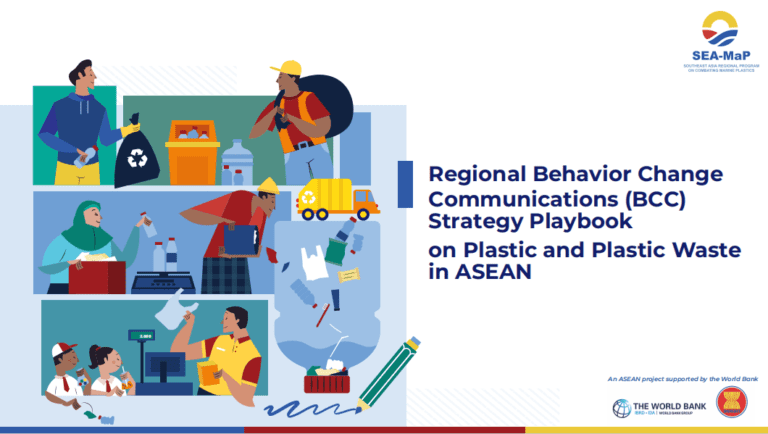
14 November 2025: SEA-MaP is pleased to announce that ASEAN has endorsed the Regional Behavioral Change Communication (BCC) Strategy Playbook on Plastic and Plastic Waste in ASEAN (hereafter ‘the Playbook’).
The Playbook is envisaged to serve as a practical guide for implementing effective BCC campaigns, targeting three key behaviors: litter reduction, decreased single-use plastic consumption, and improved sorting and recycling practices. Targeting key practitioner groups across ASEAN including governments, non-governmental organizations (NGOs)/civil society organizations (CSOs), and the private sector, the Playbook offers tools that are supported by interactive and user-friendly features to design effective and impactful behavior change campaigns.
For practitioners, the Playbook provides step-by-step tools from selecting target groups and understanding their daily realities, to choosing the right behavior change drivers, rolling out a campaign and measuring the impact. Its flexible design allows the Playbook to be applied at different scales, whether in national policies, community programs, or private sector initiatives.
The Playbook is now available for download at LINK. A Regional Workshop to socialize and disseminate the Playbook is to be conducted in January 2026.
Consulting firm for the assignment: Making Oceans Plastic Free under PT Ini Solusi Hijau
*****
The SEA-MaP Regional Project is an ASEAN project supported by the World Bank, where its objective is to support the ASEAN Member States in combating marine plastic pollution and mitigating its negative impacts. The Playbook work supports ASEAN in implementing the ASEAN Regional Action Plan (RAP) for Combating Marine Debris Action 11, which calls for the Playbook’s development. This work demonstrates the region’s commitment to reducing plastic pollution through not only infrastructure and regulation, but also by enabling the behavioral shifts needed for lasting change.